
A new saltedlolly.com: my own corner of the open web
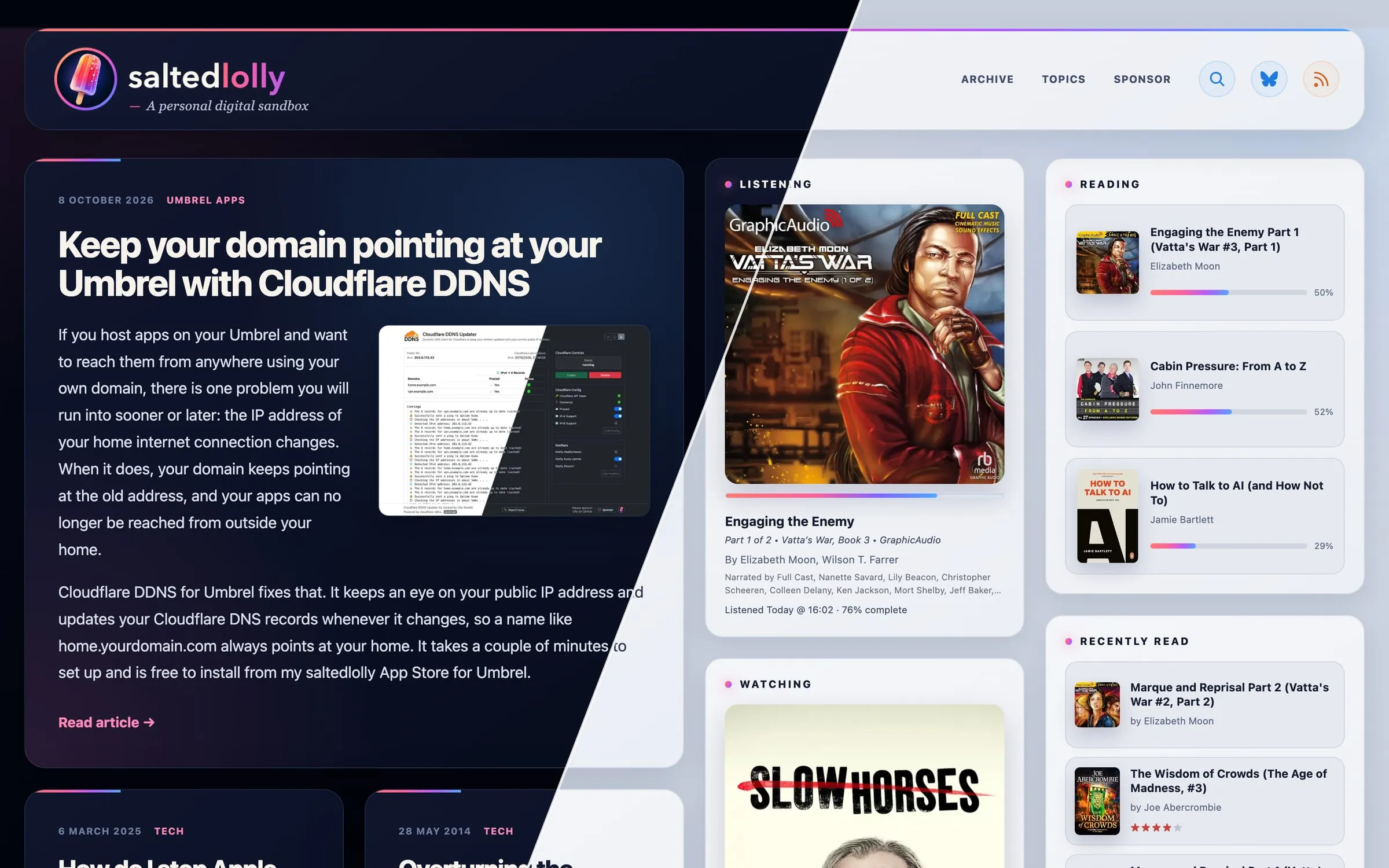
If you have visited saltedlolly.com before, you’ll notice things look a little different. For more than a decade this blog sat quietly gathering dust while I, like most people, poured my photos, thoughts and conversations into Facebook, Instagram and Twitter instead. This autumn I decided to bring it all back home. The site has been rebuilt from scratch, and this post explains what’s new and, more importantly, why.
A decade of silence
I started this blog in December 2004, and for the next few years I wrote here all the time: more than sixty posts in 2005 and 2006 alone. Then, slowly, I stopped. Facebook was easier for sharing photos with friends, Twitter was quicker for a passing thought, and later Instagram took over the pictures. By 2014 the posts had dried up completely. Apart from a single post in 2025, nothing new appeared here for almost eleven years.
The site didn’t stand still while I was away; it quietly decayed. It still wore a standard WordPress theme from 2012. The photo galleries in old posts, which were pulled in from Flickr, showed random pictures or nothing at all. Every photo I had posted from Instagram had vanished, because Instagram changed how its images were stored and the old links simply stopped working. Many of the links in old posts led to websites that no longer exist. Somebody had even slipped hidden spam links into a handful of old posts, and nobody noticed for years, least of all me.
Why rebuild it at all?
Over the last twenty years, most of what we share online has ended up on a handful of very large platforms. They are convenient and free to use, but there’s a catch: the things you post there aren’t really yours. The platform decides who sees them, what is shown next to them, whether they’re still there next year, and what happens to them if the company changes direction, gets sold or simply loses interest.
I’ve seen this happen again and again. Photo sites I relied on changed their rules. Services I used to share what I was reading quietly switched off the features that let other websites show that information. Whole communities disappeared overnight when the company behind them closed. Each time, years of other people’s memories went with them.
So I wanted somewhere I control: a place where my writing and photos live on my own website, at my own address, in formats that will still be readable in twenty years’ time. That doesn’t mean leaving the rest of the internet behind. It means connecting to it in a different way.
What’s new
A fresh look. The site has a new design, which I call Neon Midnight: a deep midnight-blue background with coral, pink, violet and blue accents, and a lighter version for anyone whose phone or computer is set to light mode. The saltedlolly logo has been refreshed too: the familiar lolly is still there, but the lettering is bolder and has more room to breathe, and there’s a new stacked version at the bottom of every page.
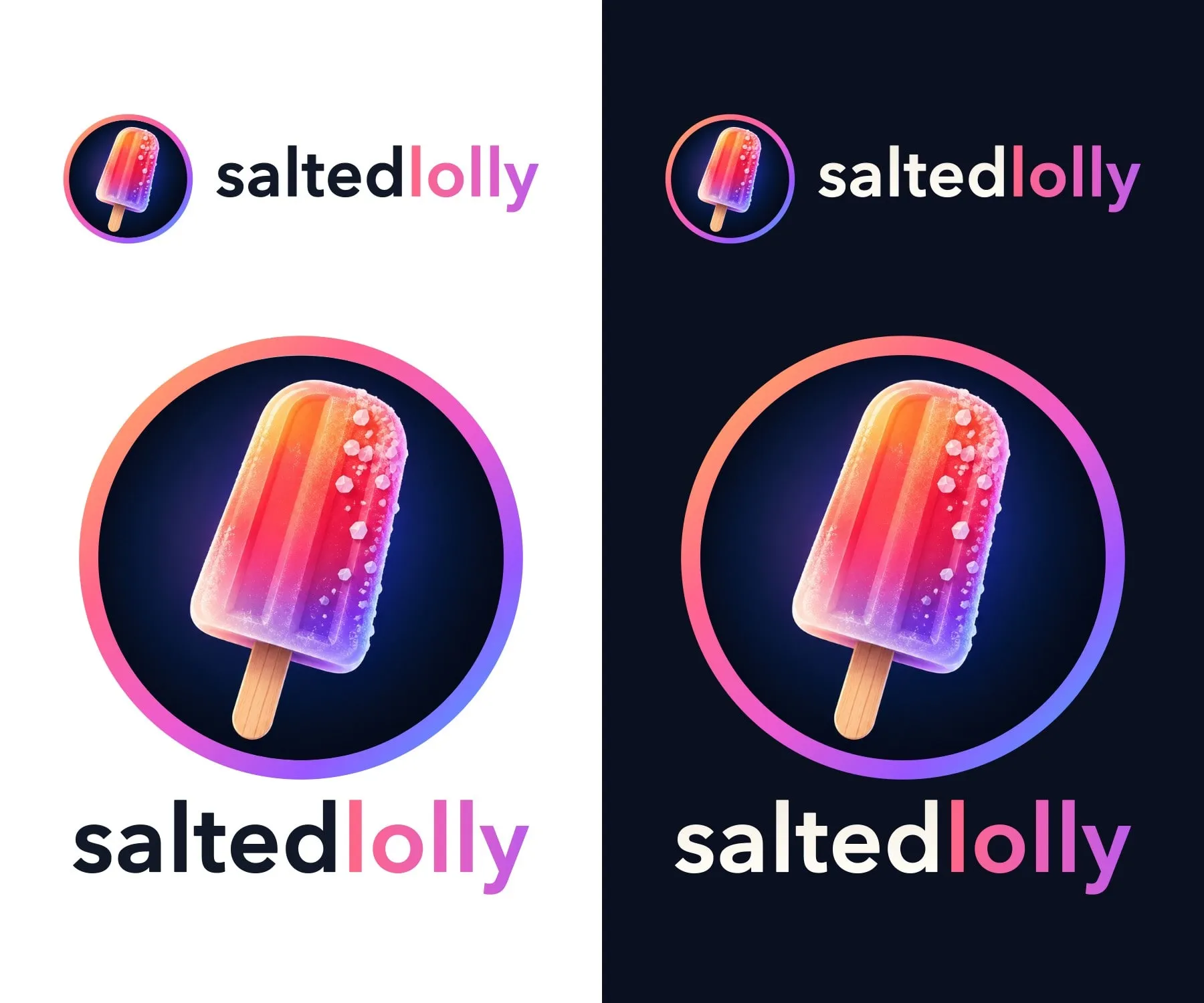
The refreshed logo, in its horizontal and stacked versions, on light and dark backgrounds.
Twenty years of posts, restored. Every post since this blog began in December 2004 has been brought across, with its original address so old links still work. Many of the early posts were about my years in Beijing, and their photos used to be pulled in from Flickr and other sites, many of which had since broken. I’ve rebuilt those galleries from my original photos, so every image in a post now lives here on the site itself.
Stories I thought were lost. The blog for Vineyard Cafe, the restaurant I co-founded in Beijing in 2006, disappeared years ago. Using archived copies of its pages and its old photo albums, I’ve rebuilt the story of how it was built, week by week. I’ve done the same for Ginkgo, the restaurant and bar I co-founded next. You’ll find them under Vineyard Cafe and Ginkgo.
A home for my photos. I no longer use Facebook or Instagram, so this site is where my photos will go from now on, one post per trip or event. Most of my Flickr albums haven’t moved over yet: so far only the ones that go with existing posts are here. I hope to bring them all across with time, so that they no longer depend on Flickr.
A glimpse of what I’m up to. The homepage shows, live, what I’m listening to (music, podcasts or audiobooks), what I’m watching, what I’m reading, my latest posts on Bluesky and the open-source software I’m working on.
Easier to find things. There’s a search box at the top of every page, an archive showing every post as a timeline, and topics for browsing by subject. The site also works in light or dark mode to match your device, and on any size of screen.
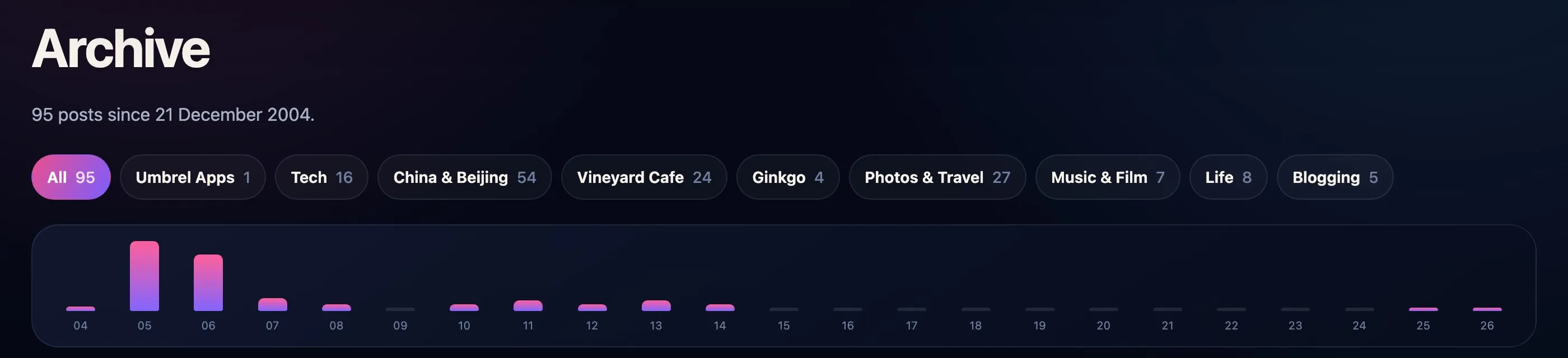
The new archive, with a bar for each year since 2004. The decade of silence is easy to spot.
Comments are back. Old comments from the original blog have been kept. New comments work differently, as I explain below.
Built on open standards
Most of the new features rely on open standards: shared rules that any website or app can follow, rather than a system owned by one company. Email is the best-known example. You can send a message from Gmail to someone using Outlook because both follow the same open rules. Nobody owns email, and that’s why it has lasted fifty years.
This site uses several of these:
Following without an algorithm. You can follow the blog with any feed reader (sometimes called an RSS reader), the same way you subscribe to a podcast. New posts arrive in the order they were written, with nothing hidden or reordered by an algorithm. The feeds also tell feed readers about new posts within seconds of them going up.
Bluesky and the AT Protocol. Bluesky looks a lot like Twitter, but underneath it is built on an open system called the AT Protocol. The key difference is that your account and your posts belong to you, not to Bluesky: you can move them to another provider, or even host them yourself, and keep your followers. The blog has its own account, @saltedlolly.com (my personal account is @olly.st), which shares each new post.
Comments that you own. When you reply to one of those Bluesky posts, your reply appears here under the article as a comment. It stays in your own account, so if you delete it there, it disappears here too. There’s a “Respond on Bluesky” button under each post that has been shared. Later I’d like to add a comment box where you can sign in with your Bluesky account and write directly on this page.
Every post, published to the open network. Each post is also published to the AT Protocol in a standard format called Standard.site, which means reading apps built on it can list and link to my writing, much like a podcast app lists episodes, without me having to sign up to each one.
Websites talking to each other. If someone writes about one of my posts on their own website, their site can let mine know using an open standard called Webmention, and their response can appear under my post. It’s how blogs used to talk to each other before social networks took over, updated for today.
Mastodon too. If you use Mastodon or another part of the “fediverse” (the network of independent social sites that work together), you can follow the blog as @saltedlolly.com
Proof that it’s really me. Anyone can make an account called “Olly”, so how can you tell which ones are mine? The blog’s Bluesky account is named after the website itself, @saltedlolly.com, and Bluesky only allows that name once the account proves it controls the website’s address. My profiles on other sites, such as GitHub, link to this site, and the site links back to each of them. That two-way link, called rel="me", is how Mastodon, for example, puts a green tick beside a website on someone’s profile.
Posts that other software can understand. Each page also carries small hidden labels, called microformats, that tell other software what it’s looking at: who wrote the post, when, its title and where else it was shared. That’s what lets another website show a tidy preview of my post when it responds, without either of us using the same platform.
Part of the IndieWeb. Many of these ideas come from the IndieWeb, a community of people who run their own personal websites instead of relying on big platforms. One of its principles sums up how this site works: publish on your own site first, then share copies elsewhere. Everything I write lives here, and Bluesky gets a link back to it, not the other way round.
Why I left WordPress
This site ran on WordPress from the very first post, and it served me well. But WordPress is now more than twenty years old, and its biggest strength has become its biggest weakness. Most of what a WordPress site can do comes from themes and plugins written by other people, and each one runs with full access to the whole site. One badly written or abandoned plugin is all an attacker needs, which makes them a gaping security hole and a big reason WordPress sites are hacked so often. Keeping it all safe means constantly updating WordPress itself, the theme and every plugin. Those hidden spam links in my old posts are a good example of what happens when nobody is watching.
Even Cloudflare thinks this needs fixing: it has built EmDash, a new open-source alternative to WordPress in which every plugin runs sealed off in its own sandbox and can only do what you’ve allowed.
The new site is built with Astro, an open-source tool for building websites (EmDash is built on it too). Instead of putting each page together from a database every time someone visits, Astro builds the pages in advance as plain, ready-made web pages. That makes them fast to load and leaves very little for anyone to attack. Only the live panels, like what I’m listening to, run code on the server.
My posts are now simple text files, written in a format called Markdown, each in a folder with its photos. They live in my own repository with a full history of every change, so nothing is locked inside a database or tied to one piece of software. If something better comes along in another twenty years, the posts can move with me.
It has also been a chance to learn something new. I’d never used Astro before this project, and building the site myself meant I could add exactly the features I wanted, including all the open standards above.
No tracking
There are no adverts, no tracking cookies and no cookie banner. I count visitors with Cloudflare’s privacy-friendly analytics, which doesn’t use cookies or follow you around the web. The site itself is built with Astro, its code is stored in my own repository, and it runs on my own server.
What’s next
There’s plenty still to do. I have well over a hundred old Flickr albums waiting to move over, each as a post of its own, older posts that need tidying, and descriptions to write for hundreds of photos so that people using screen readers can enjoy them too. I’d also like to move my reading list away from Goodreads, which is owned by Amazon, to an open alternative built on the same AT Protocol as Bluesky.
If you’ve read this far, thank you. If you’d like to keep up with new posts, follow @saltedlolly.com on Bluesky, add the feed to your reader, or just come back now and then. And if you have memories from any of the old posts, especially the Beijing ones, I’d love to hear them in the comments.
Comments
Other websites can respond by sending a Webmention.
Powered by Atmosphere Comments for Astro